Competency to capability: from curriculum to training programme for data professionals
Data professionals in Dutch research performing organisations (RPOs) are key in the transition to open science. They make researchers aware of the benefits of managing their data properly, help them make their data FAIR (Findable, Accessible, Interoperable and Reusable), deliver training, and are instrumental in embedding open science within their organisation. The role is developing rapidly, and with it the competencies required to fulfil the job. According to LinkedIn, Data Steward was one of the fastest growing jobs in 2024!
To meet the growing demand for training, Research Data Netherlands (RDNL) is developing a national training and community platform for data professionals in close collaboration with relevant parties. Funded by Open Science NL, this project now has published its first two outputs: a curriculum description, and a plan to engage stakeholders in the platform.
 Curriculum
At the start of the project in early 2025, the RDNL team asked itself: what do we mean by a curriculum for data professionals? Curricula are usually fixed paths: one sequence of courses, one type of learner, one destination. But data professionals aren’t cut from a single template. They bring diverse expertise, tackle different challenges, and require flexible, personalised development. Moreover, with RPOs shifting toward open science, the role of the data professional will evolve, and so should the way we train and support them.
This implies that: 1) a curriculum for data professionals must be flexible, tailorable to the needs of individual data professionals, and 2) such a curriculum should have a lifelong learning focus, not necessarily embedded in a formal education. The curriculum therefore distinguishes between two parts:
- A competency framework;
- A curated and flexible training programme that builds onto this competency framework.

Relation between the RDNL competency framework with seven competency areas and the training programme. This programme builds on the competency framework and will be developed incrementally in the coming period. Each training has its own planning, prerequisites, learning objectives, etc. and can be a building block in a learning path.
Competency framework
At the heart of the curriculum is the competency framework. Based on several national and international frameworks, it describes seven competency areas, consisting of competencies, knowledge and skills,and topics important for data professionals. These areas intend to reflect the breadth of the data professional role:
- RDM, FAIR principles and open science;
- Research software management;
- Data infrastructure;
- Policy and governance;
- Legal and ethical responsibilities;
- Training and awareness raising;
- Transversal skills.
The competency framework is not meant to be prescriptive. Not every competency area will be relevant (or required) for every data professional, or not to the same extent. Rather, the framework illustrates the areas that data professionals can specialise in, and helps build a training programme by clearly defining its scope.
Training programme
The national training programme will be a collection of trainings for data professionals that address the competency areas from the RDNL competency framework. To build the training programme we work towards:
- Collaborations: RDNL currently provides two trainings for data professionals, but there are many other training providers. In the coming period, we will therefore collaborate with others to embed relevant trainings into the training programme.
- Badging: Data professionals will be able to obtain a badge as a form of certification for following one or more of the trainings in the training programme. An RDNL badging policy is underway and expected by the end of Q1 of 2026.
- Learning paths: With the selected trainings in the training programme, we will create learning paths for data professionals to further professionalise themselves beyond the basics.
Future proof
By building a dynamic training programme on the solid basis of a competency framework, the curriculum allows for long-term sustainability and community-driven growth. The training programme will be developed and refined in the coming years. In the meantime, the curriculum can already help data professionals to reflect on necessary skills, career progression, and professional recognition. For academic institutes, the curriculum can help design training strategies and support staff development.
We invite data professionals, their employers, research institutes, and training providers to explore the curriculum and engage with us as the project evolves.
Stakeholder engagement
The RDNL training and community platform has to sustain beyond the project lifetime of four years. To help ensure this, a Stakeholder Engagement Plan has been put in place setting out stakeholder groups, engagement methods and activities to support the co-development of a sustainable national training platform.
The first phase of engagement focuses on bringing diverse stakeholders on board to co-create and understand the joint vision of our project. Stakeholder engagement activities include the continuation of interviews with key players and consultations to inform an initial exploitation overview for the platform to be discussed at the 2026 Stakeholder Forum.
In the second half of the project, stakeholder engagement will focus on future scenarios for the platform and support the development of governance options and a sustainability plan. Workshops, a field survey and annual Stakeholder Forums will facilitate the co-development process and buy-in required to transition from the current project structure to a future governance and business model for the platform.
Although the engagement plan is in place to guide internal activities, the document will soon be open for all to read on Zenodo:
Read the stakeholder engagement plan
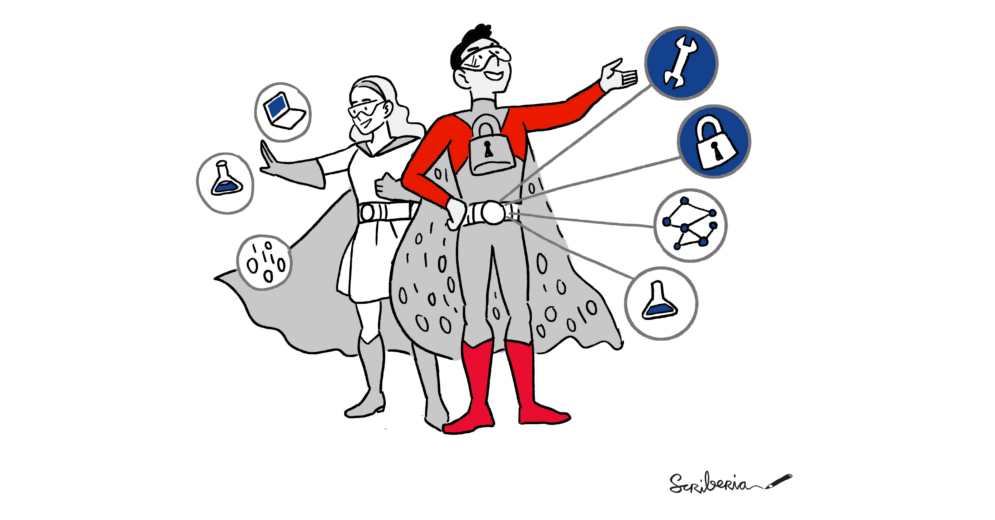
This image in the header is an adaption of the image created by Scriberia for The Turing Way community. https://doi.org/10.5281/zenodo.4323154 (CC-BY).