

 Curriculum for data professionals
RDNL is actively working on a national curriculum for data professionals in research performing organisations in the Netherlands.
The curriculum is being developed for data professionals to help them professionalise and (further) grow in their careers. It will not only focus on novice data professionals, but also on experienced data professionals who seek more in-depth knowledge or specialisation in specific areas. For employers of data professionals, the curriculum can provide a way to make explicit what competencies they expect from a data professional and will help them develop their workforce through appropriate training opportunities. Finally, the curriculum can help training providers to understand and improve the relevance of their training content for data professionals and potentially include their training in the training programme.
The full initial curriculum is published on Zenodo (CC BY 4.0).
Training vs. education
The national curriculum focuses on life-long learning (LLL), ‘learning to do’ that can be applied immediately on the job. It does not offer a formal education such as a bachelor’s or master’s degree for data professionals. Therefore, we use the term training(s) instead of education.
Components of the curriculum
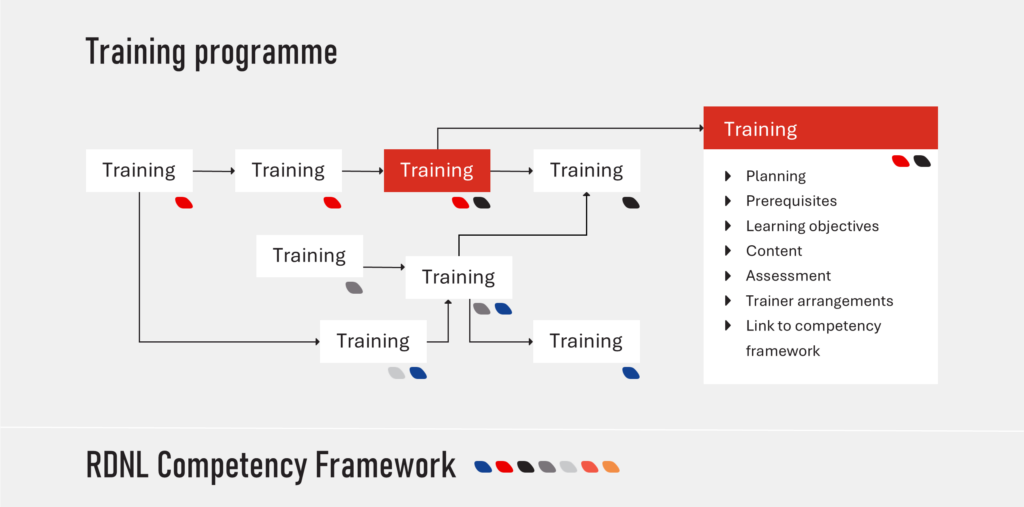
Organising training for professionals in an evolving field such as data stewardship requires flexibility to adapt to changing requirements. It is the intention of the curriculum to lay the foundation on which to build a flexible and future-proof national training programme. The national curriculum will consist of the following components:
A description of the data steward
The role, tasks and position of the data steward.
A competency framework
Which specifies what competencies data stewards can develop and that defines the boundaries of the national training programme.
A training programme and learning paths
With trainings offered by RDNL as well as other training providers. Each training can form a building block in a learning path.
Assessment and badging
Learners who successfully complete trainings in the curriculum will be awarded digital badges. The infrastructure and policy for this are currently being developed and implemented.
Partnerships with other training providers
To create a relevant training programme in line with the RDNL competency framework.